Club history · 1982–1991
A decade in the top flight
Linfield fixtured for Crossgar, the Gorman affair, Intermediate Cup runs, the RUC at Newforge, and a small pitch that took no prisoners.
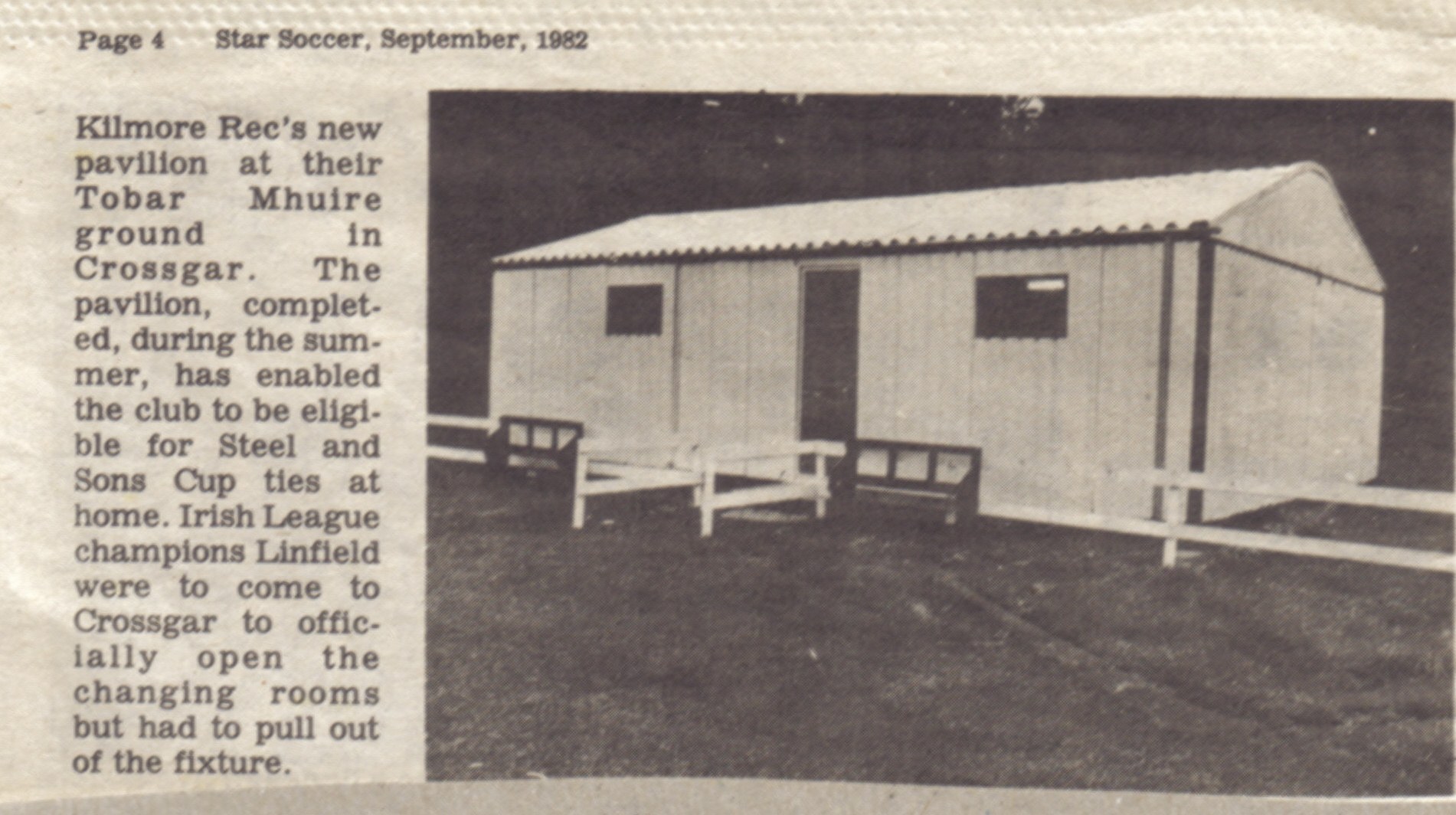
Over the summer of 1982 the club built a new pavilion at the Tobar Mhuire ground, and it changed what Kilmore Rec could do. Star Soccer photographed it that September and explained why it mattered: the pavilion “has enabled the club to be eligible for Steel and Sons Cup ties at home”. That is the reason the club’s name starts appearing in the intermediate game’s Christmas competition from this season on.
It also brought a visitor nobody in Crossgar had seen before. To open the changing rooms the club invited Linfield, and the Blues put the date in their pre-season diary for Monday 17 August 1982, in a fortnight that also took them to Stoke City and brought Middlesbrough to Windsor Park. Kilmore Rec, Amateur League Division 1B champions, were on that list. Then, in Star Soccer’s words, the Irish League champions “had to pull out of the fixture”. Whether anyone ever did open the pavilion formally, the club would still like to know.
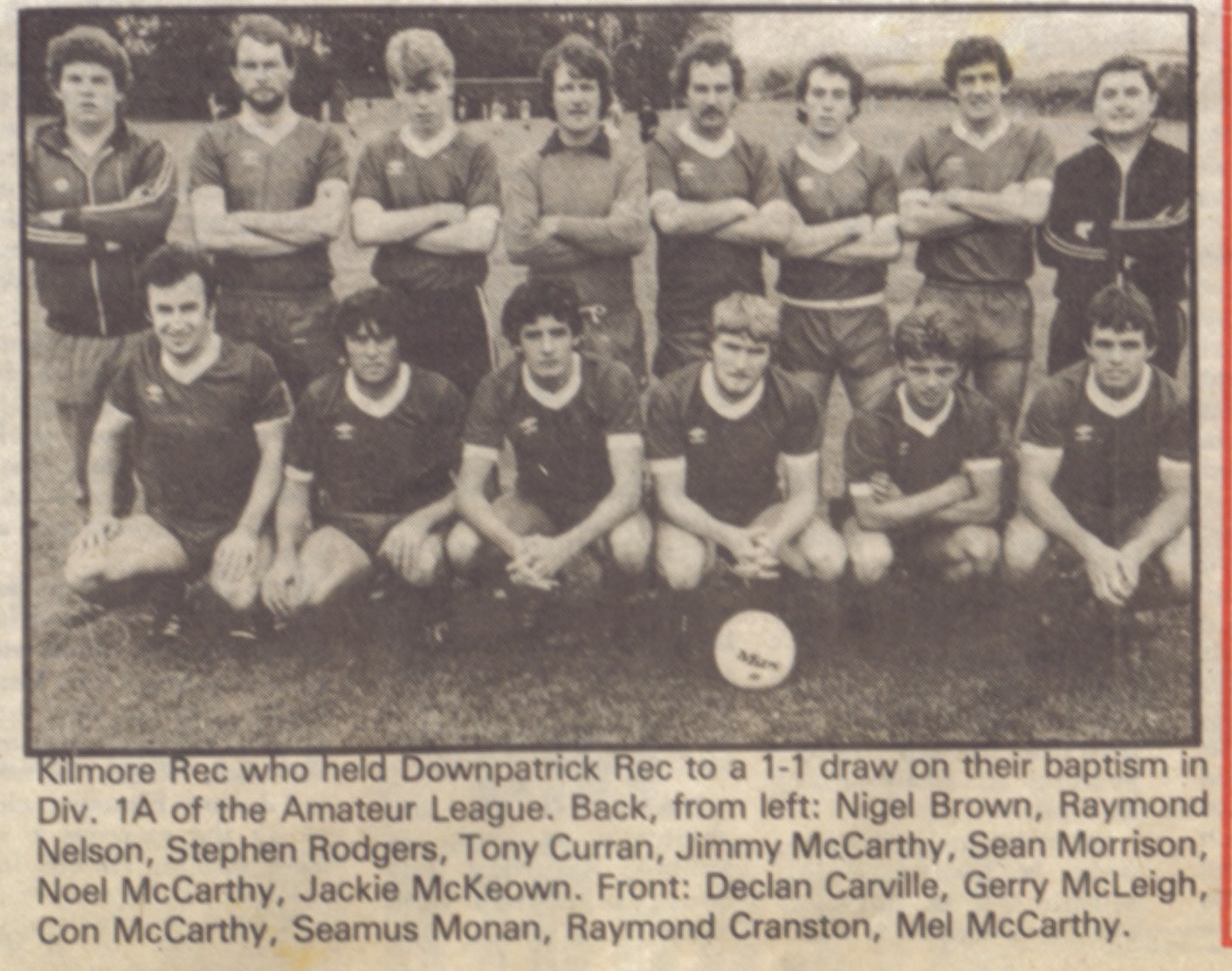
The first day in the top flight came that same month. Kilmore opened their Division 1A account with a 1–1 draw against Downpatrick Rec, and the side that played it was photographed for the paper: Nigel Brown, Raymond Nelson, Stephen Rodgers, Tony Curran, Jimmy McCarthy, Sean Morrison, Noel McCarthy and Jackie McKeown across the back; Declan Carville, Gerry McLeigh, Con McCarthy, Seamus Monan, Raymond Cranston and Mel McCarthy in front.
Linfield reserves did make it to Crossgar a month later, and were sent home. In the second round of the Steel & Sons Cup in September 1982 — the competition the new pavilion had just made possible — Kilmore held Linfield Swifts at arm’s length all afternoon, “unable to make any impression on a strong defence in which McCarthy and Carville covered superbly”, and went through to meet Killyleagh.
The Gorman affair, 1983
The following season brought the strangest episode in the club’s history, and one that would repeat itself, inverted, eighteen years later. In November 1983 Kilmore reached the semi-final of the Border Cup and lost it to Dunmurry YM, 4–3 on penalties after extra time at Aircraft Park. Dunmurry were bottom of the table with one point from eight games, but they had just signed a defender, Geoff Gorman, who had strengthened them considerably. He was also, it emerged, a professional, and ineligible. Dunmurry had made no secret of playing him — the story broke because their own matchday programme drew attention to the semi-final win. The IFA reprimanded club and player. The Amateur League threw Dunmurry out of the competition in January, cancelled the final altogether, and handed the cup and the medals to Shorts, the holders. Kilmore, beaten by a side that should not have been able to field him, were not reinstated and got nothing.
Note that, because the club would find itself on the other side of the same rule in 2001.
The Intermediate Cup years
In the top flight the club held its own and made noise in the Irish Intermediate Cup besides. In February 1983 Kilmore went to Annalong and won 3–1, two up inside thirteen minutes and McHugh finishing it from a corner, to earn a tie against the aircraft-makers Shorts with only six B-League sides left standing. Shorts were beaten too — 2–0 at Aircraft Park, both goals from the penalty spot — and that put Kilmore into the fourth round at home to Chimney Corner, the holders. The News-Letter called it the tie of the round and warned that Kilmore were “very strong and difficult to beat on their own ground”. So it proved. O’Hare equalised, extra time settled nothing, and the holders survived a shoot-out that ran to sudden death: Chimney Corner nine, Kilmore Rec eight.
In November 1987 Banbridge Town came to Crossgar and were sent home beaten 4–1, a result their local paper called a shock and, a week later, “the Kilmore Rec debacle”, grumbling that Town’s strike force had been “stifled by the size of the Kilmore pitch”. The small pitch took no prisoners. Another Intermediate Cup win, over Newry Town Reserves, followed in 1988.
In the autumn of 1984 an unbeaten away record earned the club an Irish Cup preliminary-round tie against the RUC at Newforge, previewed in the Belfast News-Letter under the headline “RUC to ‘arrest’ Kilmore”. The police won it 2–1 on 3 November, Geoffrey Ferris opening and Sammy Adams settling it after a moment of magic from Mark Caughey, who would go on to play for Northern Ireland. Ireland’s Saturday Night put it more bluntly that evening: “Police knock out Kilmore”.
Windsor Park, December 1987
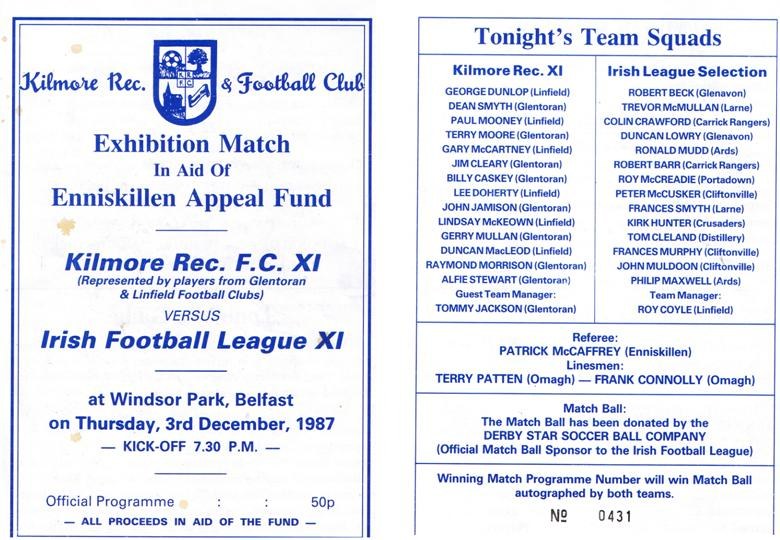
On Thursday 3 December 1987 a Kilmore Rec FC XI played an Irish Football League XI at Windsor Park, in aid of the Enniskillen Appeal Fund, four weeks after the Remembrance Day bombing. The Kilmore side was made up entirely of Glentoran and Linfield players — George Dunlop, Paul Mooney, Gary McCartney, Lee Doherty, Lindsay McKeown and Duncan MacLeod of Linfield; Dean Smyth, Terry Moore, Jim Cleary, Billy Caskey, John Jamison, Gerry Mullan, Raymond Morrison and Alfie Stewart of Glentoran — with Tommy Jackson as guest manager against Roy Coyle’s selection. The programme cost fifty pence and every penny went to the fund.
How a village club’s name came to be on that fixture is not something the club’s own records explain, and it is one of the better questions on this site.
The Steel & Sons Cup, the intermediate game’s Christmas showpiece, was no stranger either. Kilmore entered it season after season through the eighties — Linfield Swifts in 1982, a replay against Killyleagh, Ballyclare Comrades, Dundela, a tie at GEC’s Recreation Road in Larne — a quarter of a century before the club finally lifted it.
Combative years
A local derby at Ballynahinch on New Year’s Day 1976 “got out of control for a brief period in the second half when four players were ordered off”, and in January 1980, defending the Junior Shield, a tie against Wakehurst was abandoned altogether and ordered replayed at Ballee by the Co. Antrim FA. In December 1981 the league’s disciplinary column recorded a six-week suspension for Noel McCarthy and two weeks for his brother Mel — the same pair who had won the Shield between them eighteen months earlier. Mel was sent off again the following September. The McCarthys collected suspensions much as they collected medals.
By 1988 the team was managed by Davy Graham, an ex-Linfield player, who spent that spring, in the words of the Belfast News-Letter, “striving to keep Kilmore in the top flight”.
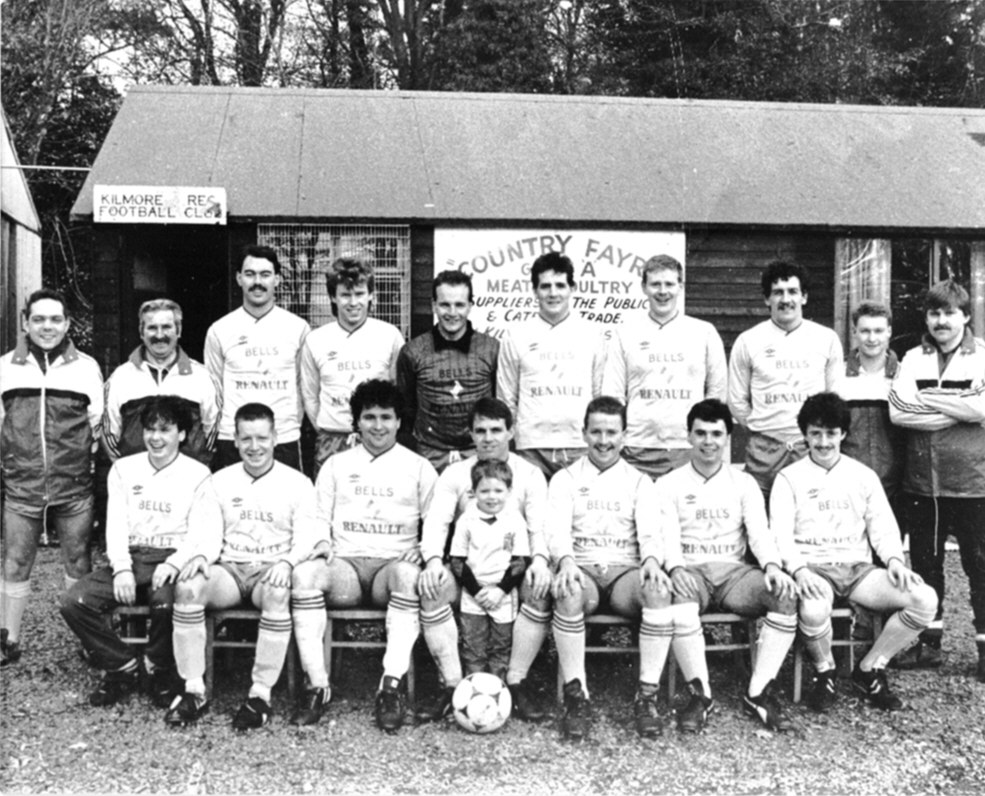
The squad photograph from that season is worth looking at twice. Graham stands at one end of the back row and Tom Kennedy at the other; Paul Moore is among the players between them. All three would manage Kilmore Rec — Graham then, Kennedy within three years, Moore not until 2006. One team photograph, three decades of the club’s dugout.
The decade turns
There was one more run at the big time before it did. In the first round of the 1989–90 Irish Cup Kilmore knocked out Ballymoney United — “the only upset in the first round”, the News-Letter reckoned — and were rewarded with a trip to Loughgall, the Mid-Ulster champions. They lost 2–1 in what the reporter called a bruising encounter, eight players booked, five of them Kilmore men. Relegation in 1989–90 brought the decade to a bruising end in every sense.
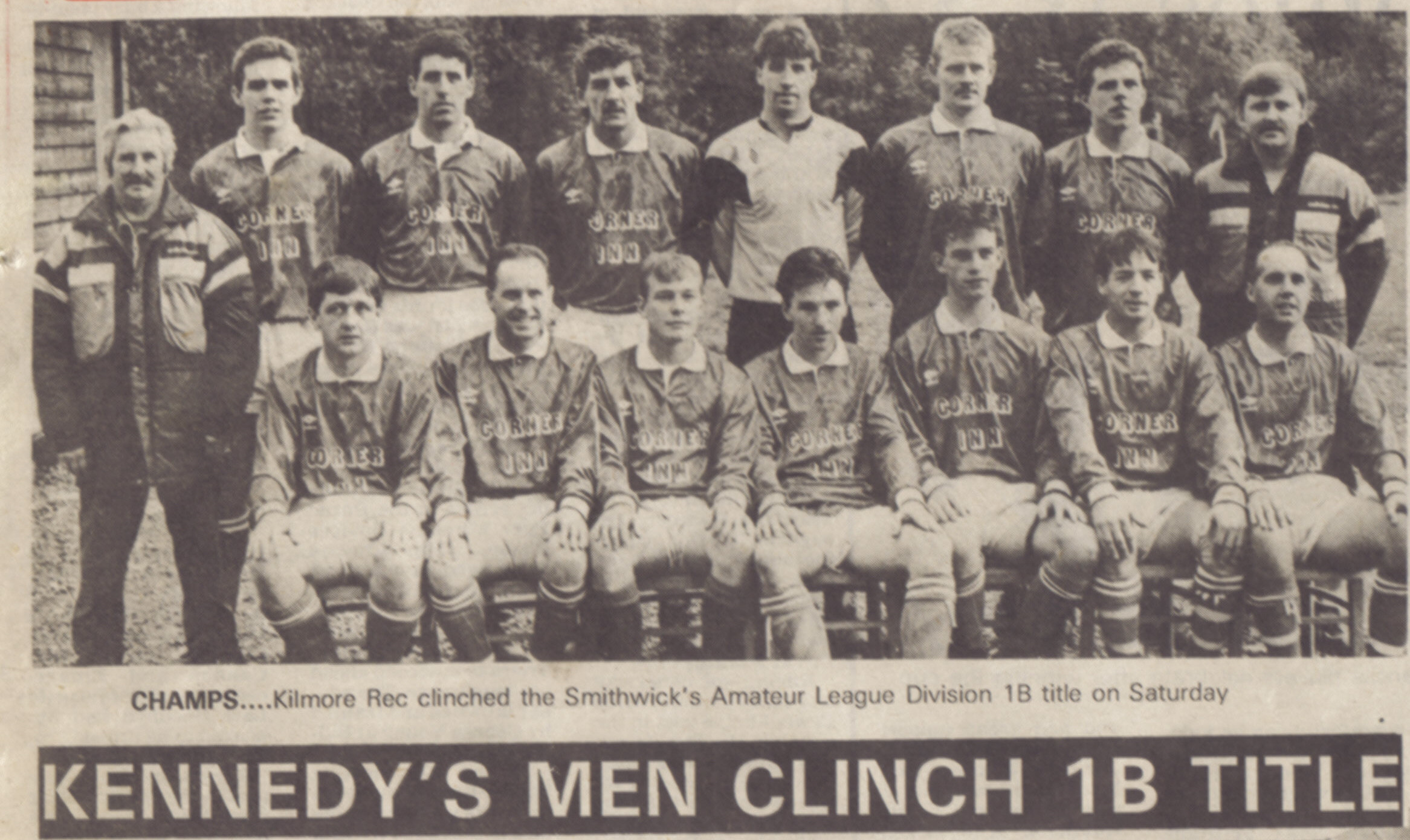
The response said much about the club. They were champions of 1B again at the first time of asking in 1990–91, back up just as the league was about to reinvent itself.
 Add to your home screen